


Dr. Cowans
Anesthesia's the easiest job in the world until something goes wrong. It's 99% boredom and 1% scared-shitless panic.

Most scenes together: Dr. Wheeler & Dr. Bellows (3)
Anesthesia's the easiest job in the world until something goes wrong. It's 99% boredom and 1% scared-shitless panic.
Doctors make the worst patients. They know too much.
Honey, come on.
Don't call me honey.
I'm trying to tell you about my day. Something that happened.
Your days are always the same.
What is that supposed to mean?
Just politics, that's all. Who said what to whom. Who's rising, who's falling. Who's made a good move, a bad move. Politics!
Somebody has to be interested in hospital politics. You certainly are not.
I thought you were a surgical resident, not a political one.
I like politics. They interest me. Just because you're always looking for...
You want me to heat up the dinner, is that it? I want some respect.
Susan, come on. Don't leave again.
Why can't you share half the responsibility?
I share more than half the responsibility!
No need to shout.
Why are you running off? You think I want this? Let me tell you something. I make concessions for this so-called relationship.
I know it's hard on you politically.
Susan, don't go.
You know what the trouble with you is? All you care about is being chief resident.
You know what your trouble is? You don't want a relationship. Look at you. You run away from it.
This is ridiculous.
You don't want a lover...you want a goddamn wife!
Bastard.
Okay, Mrs. Greenly, it's time to wake up. Okay, Nancy? Mrs. Greenly? Wake up. Nance, can you give me a cough, please? Nancy? [checks her eyes] Oh, Jesus Christ! Her pupils are fixed and dilated.
What?
The pupils. They're fixed. Dilated.
Oh, my God!
 Dr. George
We have a happy lab here. It's precise. There's nothing left to chance. There are no mistakes. The charts are right here. There's no mystery. They're right here. What is it you wanted?
I'd like to look at them.
Dr. George For what reason?
I'm interested in unexplained coma following routine surgery.
Dr. George You're interested?
I'm more than interested.
Dr. George My anesthesiology staff is more than interested. We're deeply concerned.
I understand.
Dr. George I'm not sure you do.
Perhaps something was missed?
Dr. George Missed? Every professor of anesthesia, most of our staff, more than 40 experts have gone over these charts. You think something was missed?
But if anything links them together...
Dr. George If anything linked them, we'd know it. Here they are, 10 cases.
There are now 12. Different ages and sexes. Different surgeons and anesthetists. Different methods of induction. They share nothing in common except they all emerged with unexplained coma.
Dr. George We're certainly not neglecting that problem.
I didn't say you were. Do you mind if I have a look?
Dr. George I'm afraid I do mind. Thank you for your interest, however misplaced. Good afternoon.
 Dr. Harris
I've had a rather hysterical call from Dr. George in anesthesiology. Dr. George is a powerful person here, not only because of his position. There are other reasons.
I gather.
Dr. Harris What does that mean?
Just because he has a rich wife, he's able to throw his weight around.
Dr. Harris You're looking for truth and justice.
I'm looking for fairness.
Dr. Harris In fairness, you've challenged the professional competence of a chief of service at this hospital. And he didn't take it well. No reason he should. Now he's out for blood.
I've noticed.
Dr. Harris Sue, believe me, I'm on your side for all kinds of reasons. I don't want to let another chief of service get one of my house officers fired.
Dr. Harris, I just wanted to look at his charts.
Dr. Harris Sue, right now, I can protect you because you're good. And frankly, because you're a woman.
I don't want concessions.
Dr. Harris At the moment, you'd better take any you can get.
You know what happened to Greenly?
Dr. Harris Yes.
What happened?
Dr. Harris She died.
How do you feel about that?
Dr. Harris How do I feel? I feel...
She was my best friend. She understood me. She understood me. It's not fair. None of this is fair.
Dr. Harris Here.
Nobody understands. No one.
Dr. Harris I know, I know.
Dr. Harris, the secretary of HEW is on the phone from Washington.
Dr. Harris Call back. Too many of us shut ourselves off from our feelings. We don't explore them. We don't understand them. We don't understand ourselves. It's the toughest thing about our profession.
Dr. Harris...
Dr. Harris I'll take care of the politics. You just look out for yourself. Take the weekend off, Sue. Go walk on the beach. Get away from the hospital.
I'm so embarrassed by this.
Dr. Harris Don't be. Don't be. Our emotions are what make us human.
Dr. Harris You've put me in a difficult position. It seems you know everything.
You're George.
Dr. Harris I wonder if you can understand, if you can take the long view, the view of a person in my position.
You did it.
Dr. Harris No decision is easy, Sue. It only looks that way when you're young. When you're older, everything is complicated. There is no black and white, only gray. But our society faces momentous decisions. Decisions about the right to die. About abortion. About terminal illness, prolonged coma, transplantation. Decisions about life and death. But society isn't deciding. Congress isn't deciding. The courts aren't deciding. Religion isn't deciding. Why? Because society is leaving it up to us, the experts. The doctors.
You're crazy.
Dr. Harris Americans spend $125 billion a year on health. More than defense. Because Americans believe in medical care. These great hospital complexes are the cathedrals of our age. Billions of dollars, thousands of beds. A whole nation of sick people turning to us for help.
You, you ought to see somebody.
Dr. Harris They're children, Sue. They trust us. We can't tell them everything. Our job is to make things easier for them. I'm sure you agree.
You're killing people.
Dr. Harris We must always take the long view. Not of the individual, but of society as a whole. Because medicine is now a great social force. The individual is too small.
Dr. Harris That's the drug. It produces abdominal spasm and peritoneal symptoms. It must be very painful. It's too bad. But look at it from the practical standpoint. Somebody has to make these decisions. We can't wait around forever. If society won't decide, we'll decide. We'll make the hard decisions.
Dr. Harris This is Dr. Harris. Schedule an emergency appendectomy in O.R. 8. It's a member of the house staff, Dr. Wheeler. I've examined her. She requires immediate surgery.
Jim, I know it sounds silly but, supposing you wanted to put people into a coma, what would you do?
 Jim
You mean on purpose?
 Pathology Resident
Diethyl para-amino tannadol.
Jim No, no, leaves a serum trace.
Pathology Resident Yeah, if you know to look for it.
Jim But it also peaks alk phos. That's a real giveaway. Besides, who can get tannadol?
Pathology Resident Well, then you can use paradine.
Jim No, it has a taste. We'd all make great murderers. I mean, who knows better about murder than a pathologist?
Pathology Resident It sure keeps my wife in line.
Mark, it's so awful! It's so terrible.
Take it easy. Honey, slow down.
He was trying to kill me. And I had to keep going. And all the bodies. It's horrible!
Take it easy. Slow down.
Mark, it's all happening. It's really happening. Somebody's putting people into comas. They're murdering them. No, no, really. Kelly's dead. I was down there. I found the gas line. It starts in the basement and it goes up the main tunnel then plugs into the oxygen line in the ceiling that goes to O.R. 8.
Honey, slow down.
They're killing people with carbon monoxide in O.R. 8. They have a radio to turn the valve.
I believe you.
All the cases happened in O.R. 8. And they all went to the Jefferson Institute. And this guy, he chased me all over. And there were so many bodies.
It's all right. It's okay.
And this is real. Call the police. We have to do something! This is real, Mark. I can prove it.
Sure, you can. You can. Just lie down.
This is real.
I know you can. Now one thing at a time. I want to give you a Valium and how about a cup of tea to settle you down? A cup of hot tea? Then we're going to talk after you settle down. So you just rest right here. You just stay right here on the bed? That-a-girl. That's it. You just relax.
I can't...
That's it. Just relax. Close your eyes. That's it. Okay, that-a-girl. Now, I'll get you a cup of tea.
You're so great, Mark.
Stay here, honey. Just stay right here. [calling out from the kitchen] That's a hell of a story, Susan. You really had a lot of people worried. Don't worry. Everything's going to be okay now. [quietly into the phone] She came back. No, she's here now. Of course. No, I can manage that. I'll keep her here. Look, I'd better go. [turns to find Susan gone]
Nobody else here seems to care.
Nobody else cares?
Listen. There have been 10 cases of unexplained coma in young, healthy patients in the last year. Now, don't you find that surprising? [Mark shakes his head] You don't.
Susan, this hospital does 30,000 operations a year. I'm not surprised a few turn out with serious unexplained side effects. Medicine isn't perfect. We all accept that. Don't we?
Jim First rule of crime: Keep It Simple. What's simple? Carbon Monoxide.
Pathology Resident Boring.
Carbon Monoxide?
Jim Sure, it's perfect. Anesthetist feeds the patient some carbon monoxide instead of oxygen. It's colorless and makes the blood very red so the surgeon doesn't notice anything funny. But the brain dies from lack of oxygen. End of operation - the patient doesn't wake up.
No other effects?
Pathology Resident Sure, other effects. Cardiac irritability.
Jim Which this case had.
Pathology Resident You know, it'd be much better to block the neuro-muscular junction with succinylcholine. Now that's a nice murder.
Jim Yeah, who's gonna do it?
Pathology Resident Well, who's gonna feed you carbon monoxide?
Jim That's the problem. Been about a dozen of these coma cases here in the last year. They're always different. Different case, different anesthetist, different operation. Hard to imagine it's murder.
Are you sure?
Jim What do you think? There's a conspiracy at the Boston Memorial Hospital, involving all the anesthetists?
I'm Dr. Wheeler.
You're early, aren't you, doctor?
Early?
You're supposed to come on Tuesday, day after tomorrow, when the tour is scheduled.
The tour?
Yes, it's every Tuesday at 11. The regular tour for physicians.
Could I see it now?
I'm afraid that's impossible.
I just thought as long as I'm here...
We're simply not set up for it.
May I speak with the physician in charge?
There is no physician in charge.
Well, then, your supervisor.
I have no supervisor.
Who runs the staff?
There is no staff.
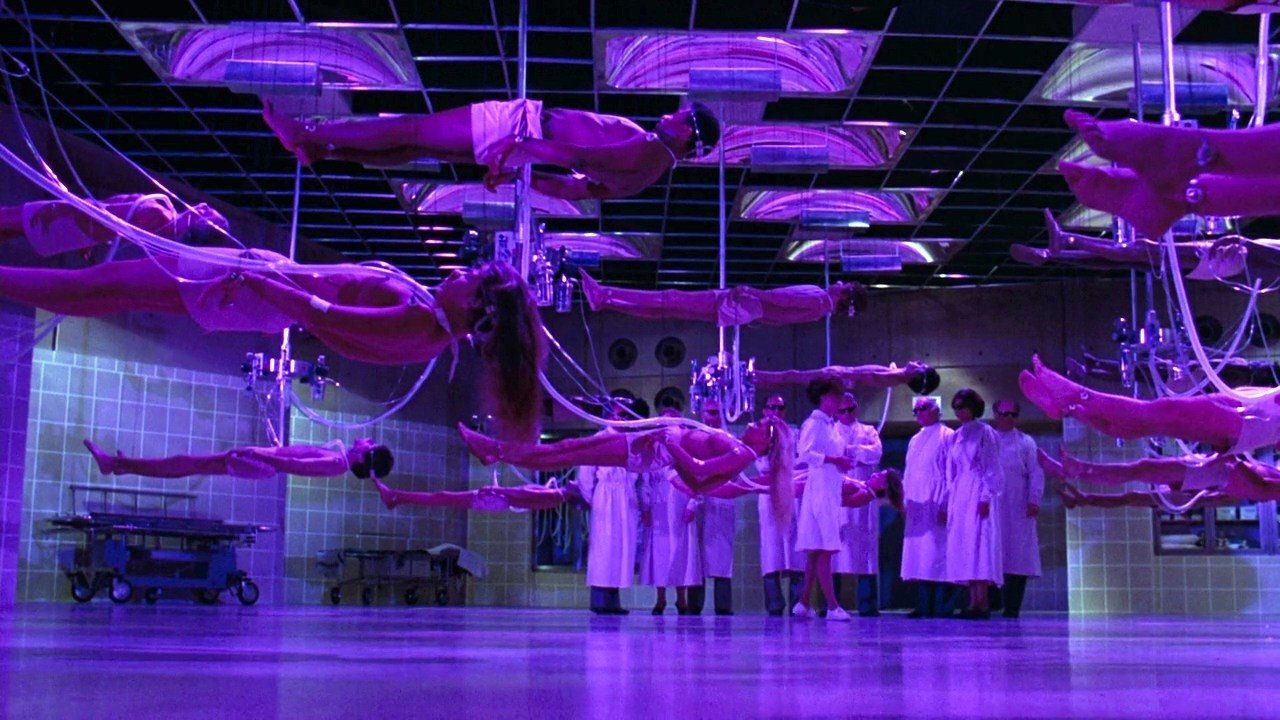
We are dealing in an area of uncertainty. An area where there are no rules, contradictory laws and no clear social consensus as to what should be done. And the cost of care for the chronic patient has become prohibitive. This is particularly the case with the long-term comatose patient. The Jefferson Institute is a government- sponsored experimental facility designed to provide quality life support to the comatose patient. I wish to emphasize no moral or ethical position is being taken here. We do not participate in the debate over whether these patients are alive or dead or whether their care should be continued or terminated. Society will decide if there will be more of these facilities or not. In the meantime, we merely provide care as inexpensively as possible.